The Luxury Store Operating System
A practical framework for improving boutique performance, client relationships, and operational discipline inside luxury retail environments.
Why Luxury Stores Underperform
Luxury brands rarely struggle because of product.
Most challenges appear inside the store environment — where execution depends on people, habits, and operational clarity.
Boutiques often run on fragmented systems: individual talent, inconsistent clienteling, and store managers developing their own operating methods.
When brands scale internationally, these differences compound.
The result is uneven performance across stores, inconsistent client relationships, and missed commercial opportunities.
High-Performing Boutiques Operate as Systems
The most successful luxury stores do not rely on individual brilliance alone.
They operate through a set of consistent practices that guide leadership behavior, associate routines, client intelligence, and relationship development.
The Luxury Store Operating System organizes these practices into five interconnected layers.
The Luxury Store Operating System
A boutique performs when leadership, operations,
associates, and intelligence work together
to support client relationships.
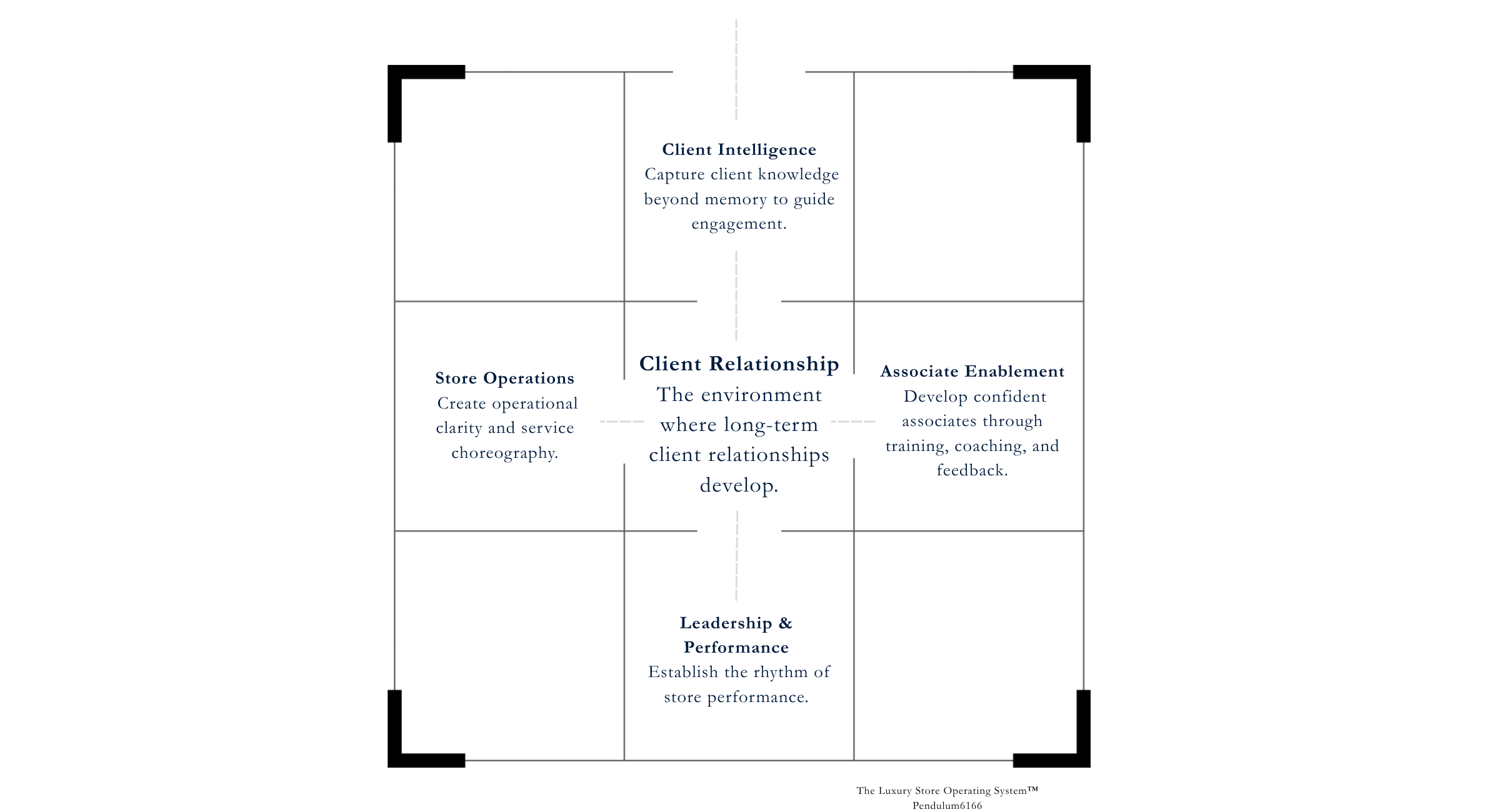
When these five layers operate as a system performance excellerates.
The Luxury Store Operating System is a framework for diagnosing and improving boutique performance.
The Five Layers
1. Leadership & Performance
Store leaders establish the rhythm of performance.
Clear expectations, daily rituals, and structured review cycles ensure the team operates with focus and accountability.
2. Store Operations
Operational clarity removes friction from the client experience.
Merchandising discipline, traffic management, and service choreography allow associates to focus on clients rather than logistics.
3. Associate Enablement
Luxury retail depends on confident, empowered associates.
Training, coaching, and performance feedback help teams develop the judgment required to serve clients at the highest level.
4. Client Intelligence
Client knowledge must move beyond memory.
Structured clienteling systems capture preferences, purchase patterns, and relationship history to guide meaningful engagement.
5. Client Relationship
The ultimate objective of the boutique is relationship building.
When leadership, operations, associates, and intelligence work together, boutiques become environments where long-term client relationships naturally develop.
From Concept to Store Execution
The 90-Day Store Performance Pilot
The Luxury Store Operating System is used as a diagnostic and improvement framework inside boutiques.
It allows leadership teams to evaluate where performance gaps exist and introduce practical changes that strengthen the store environment.
Most engagements begin with a focused pilot inside one or several boutiques before expanding across the network.
The 90-Day Store Performance Pilot applies this framework inside a real boutique environment.
The goal is to introduce operational clarity, strengthen clienteling practices, and build leadership routines that improve store performance.
The pilot allows brands to test improvements before expanding them across the retail network.
This framework is part of a broader body of work exploring how luxury retail is evolving.
I share this thinking weekly in my newsletter.